





Silvarum Scriptura - Orator Regnorum
5 Ways to Boost Your Creativity and Reconnect with Your Inner Genius
We’re born with natural creativity. Seriously. Before kindergarten, every finger painting and mud pie was a tiny rebellion against conformity.
Then life happened. School grades, spreadsheets, and the relentless hum of “responsible adulthood” shoved our wild, imaginative selves into the cupboard with the Halloween decorations.
Fear not: your inner creative genius is not lost—it’s just… dormant. Here are five ways to dig it out without poking it too hard or setting off an existential tantrum.
1. Creativity needs a suprise
Creativity begins where sanity ends. If you’re serious about boosting your creative power, start by deliberately thinking the most absurd, outrageous, or ridiculous ideas you can imagine. Don’t limit yourself to what makes sense or what other people might call “reasonable.” Your mind, like a mischievous cat, loves a little chaos. Write down a chair that folds into a submarine, a pen that doubles as a miniature jetpack, or a lamp that also dispenses confetti for celebratory moments. At first, these ideas might seem silly—or even embarrassing—but that’s the point. The most brilliant concepts are often hiding in the realm of the ridiculous, waiting for you to notice them. When you suspend judgment and let your mind wander freely, you’re essentially giving your imagination permission to run wild, unshackled by rules, expectations, or logic. And that’s where innovation is born.
2. Aim for Quantity
Don’t expect perfection on the first try. Creativity thrives on numbers, not immediate genius. The first idea you jot down is rarely the gem you’re seeking. The second might be slightly better, the seventh a glimmer of brilliance, and somewhere around the fiftieth, you might stumble across something truly extraordinary. Think of it like a treasure hunt: every idea, no matter how dull or unpolished, is a clue, a stepping stone, a raw material you can refine, combine, and twist into something remarkable. Creativity isn’t about inventing something entirely new from nothing—it’s about taking the pieces you already have and recombining them in novel, unexpected ways. The more you generate, the higher your chances of striking gold. Quantity, in other words, breeds quality. Treat your idea list as a sandbox where every grain of sand counts.
3. Relearn how to play again
Play isn’t just for children—it’s the secret weapon of anyone seeking to ignite their creative spark. When you approach ideas with a playful attitude, the pressure of logic, perfectionism, and expectation melts away. You allow yourself to experiment, to doodle, to bend rules, and to explore without the heavy weight of judgment. Think of it as a rehearsal space for your mind: the sillier, wilder, and more relaxed you are, the easier it becomes to discover connections and solutions you’d never find when you’re rigid or self-conscious. Play invites curiosity and joy, and these are the exact conditions your brain needs to unlock new perspectives. So, let go, be mischievous, and see where your imagination wants to wander. Creativity loves a good game.
4. Believe Everything Has a Solution
Optimism is a key ingredient in the creative process. When you adopt the mindset that every problem—no matter how insurmountable—has a solution, your mind becomes a laboratory of possibilities. Often, the barrier isn’t the lack of a solution, but the way we frame the problem. Change your perspective, redefine the challenge, or even approach it backwards. Sometimes the solution is disguised as something absurd or counterintuitive, and the only way to find it is to keep looking, keep experimenting, and refuse to give in to the “this is impossible” mindset. By cultivating this persistent curiosity and belief in solutions, you train your brain to see possibilities instead of roadblocks, turning obstacles into opportunities for creative breakthroughs.
5. Let Go of Your Fear of Failure
Fear is creativity’s most formidable enemy. Many people never fully explore their imaginative potential because they are terrified of doing something wrong, looking foolish, or failing outright. Yet failure isn’t a catastrophe—it’s feedback, a necessary step in the journey toward brilliance. Every misstep, every experiment that flops, brings you closer to something meaningful. Consider Thomas Edison, who tested thousands of filaments before creating the incandescent lamp. Each “failure” wasn’t a setback—it was a lesson, a clue, a step forward. By embracing mistakes as part of the process rather than evidence of inadequacy, you free yourself to take risks, to experiment boldly, and to create without the paralysing weight of perfectionism. In essence, letting go of fear is like unlocking a door: once open, your creativity can flood the room unrestrained.
Play, Fail, Create
Creativity isn’t a gift—it’s a muscle. Stretch it, bend it, tickle it, and yes, occasionally smush it flat in your attempts.
Surprise your mind, chase quantity, play like a child, believe in solutions, and fail spectacularly. Do all of this and your inner genius will start knocking on the door, waving wildly, demanding attention.
And this time? You’ll answer.
Until next time, may your adventures be wild and your mysteries ever so slightly less terrifying.

Creativity for the mystic has a different rhythm
One of the greatest illusions we’ve been sold is that only a select few are “qualified” to write. As if some hidden committee hands out golden pens to the worthy, while the rest of us should just sit quietly in the back. Absolute nonsense.
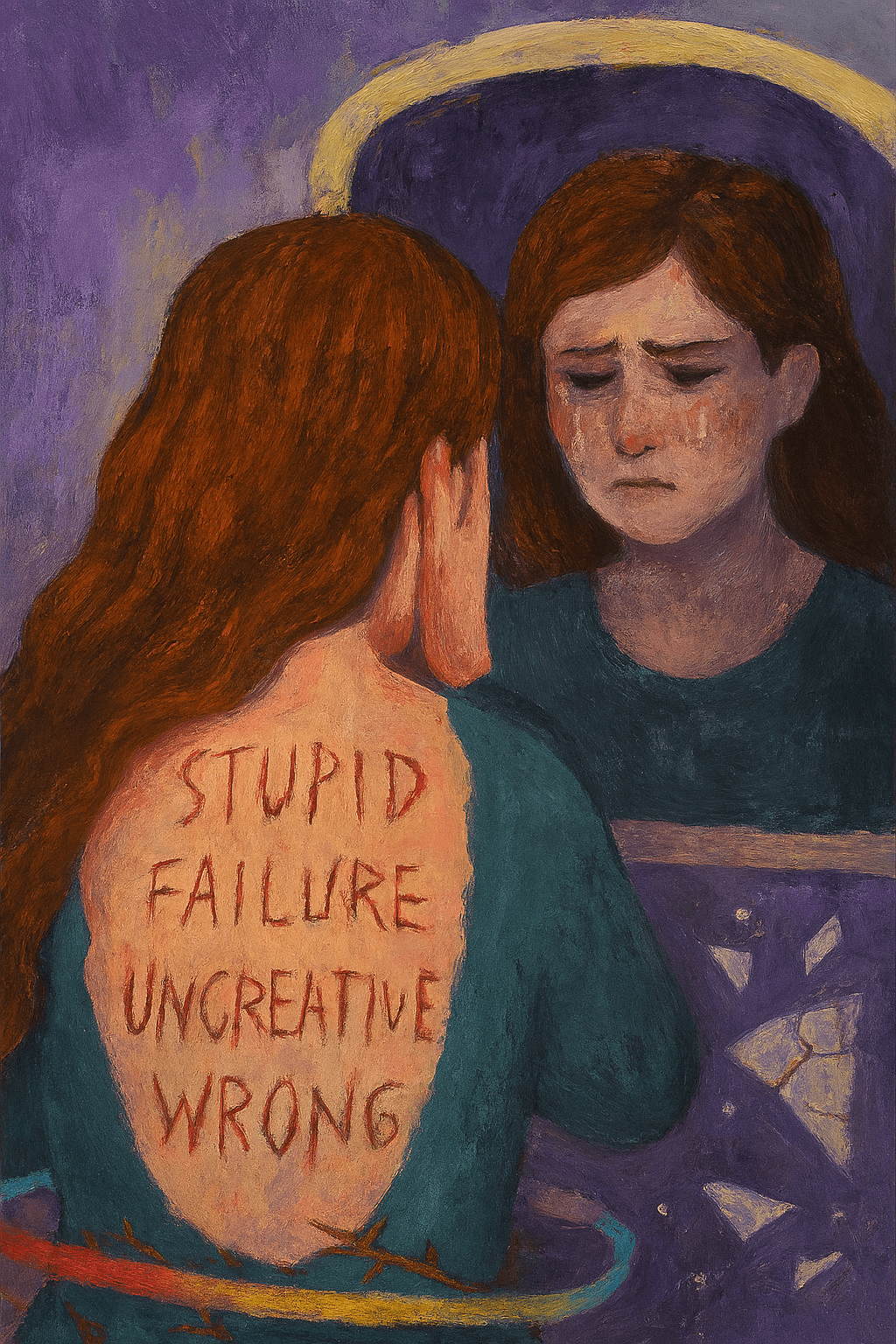
How to Silence Your Inner Critic
This post is your battle plan. Not for perfect prose, not for instant fame — but for silencing the inner critic that’s been hogging the mic in your mind. You don’t need permission to write. You just need to start.

How to find your writer’s voice
You’re standing on the shore, dipping your toes in your fictional world, when what it really needs is for you to strip down and cannonball straight into it.